Team brainstorming is a group session for finding many possible answers to one question before choosing any of them. Done well, it gets ideas out of people who would never have pitched them in a normal meeting, and ends with a few worth trying, each with someone to try it.
Done the usual way, it does neither. Research going back to the 1980s found that people brainstorming out loud as a group come up with fewer ideas than the same number of people working alone, and the fix is simple: think alone first, then build together. This guide covers the rules, a 60-minute session you can copy, seven techniques and when to use each, a worked example, and how to keep the ideas coming between meetings.
Why Group Brainstorming Often Disappoints
In 1987, Michael Diehl and Wolfgang Stroebe compared groups brainstorming out loud with the same number of people working alone, whose ideas were pooled afterwards. The people working alone produced more ideas. Their paper, "Productivity loss in brainstorming groups", traced most of the loss to the first of these three causes:
- Waiting your turn. Only one person can talk at a time. While you wait, you forget your idea, drop it because the conversation has moved on, or stop having new ones because you're holding on to it. The researchers called this production blocking.
- Fear of looking silly. People hold back the ideas they aren't sure of, especially in front of a manager, and those are often the interesting ones.
- Following the first idea. Once someone has spoken, everyone else's ideas drift toward it. The loudest person in the room sets the direction for the whole session.
None of this means teams shouldn't brainstorm. It means the session needs a structure that lets everyone think before anyone talks. That's what the rules and the agenda below are for.
The Rules of Brainstorming
Alex Osborn, the advertising executive who named brainstorming, set out four rules in his 1953 book Applied Imagination. They still hold, and two more have been added since:
- Don't judge yet. No "that won't work" until the voting. Criticism during the session stops people from offering the next idea.
- Go for quantity. The more ideas, the more good ones. Set a number to beat: 40 ideas from six people is a good session.
- Welcome wild ideas. An impossible idea often contains a possible one. It's easier to tame a wild idea than to make a dull one bolder.
- Build on each other's ideas. "Yes, and…" turns one idea into three. Combining two half-ideas is often how the best one appears.
- Think alone first. A few minutes of silent writing before anyone speaks gets you every person's ideas, not just the first speaker's.
- One conversation at a time. Side discussions mean half the room misses the idea that could have sparked theirs.
Write the rules on the first slide or at the top of the shared board, and have the facilitator point back to them.
How to Run a Team Brainstorming Session
Before the Session
- Write one question. Start it with "How might we…": specific enough to answer, open enough to allow surprises. "How might we keep subscribers past their third box?" works; "Ideas for marketing?" doesn't.
- Invite four to eight people. Mix roles: the people who talk to customers, build the product and see the numbers will each see a different problem. More than eight, and split into two groups.
- Send the question a day or two ahead. People who've slept on it arrive with ideas, and the quiet ones arrive with theirs written down.
- Pick a facilitator who won't pitch. Their job is the clock, the rules and making sure everyone gets heard, not winning the vote.
The Session: 60 Minutes
| Step | What happens |
|---|---|
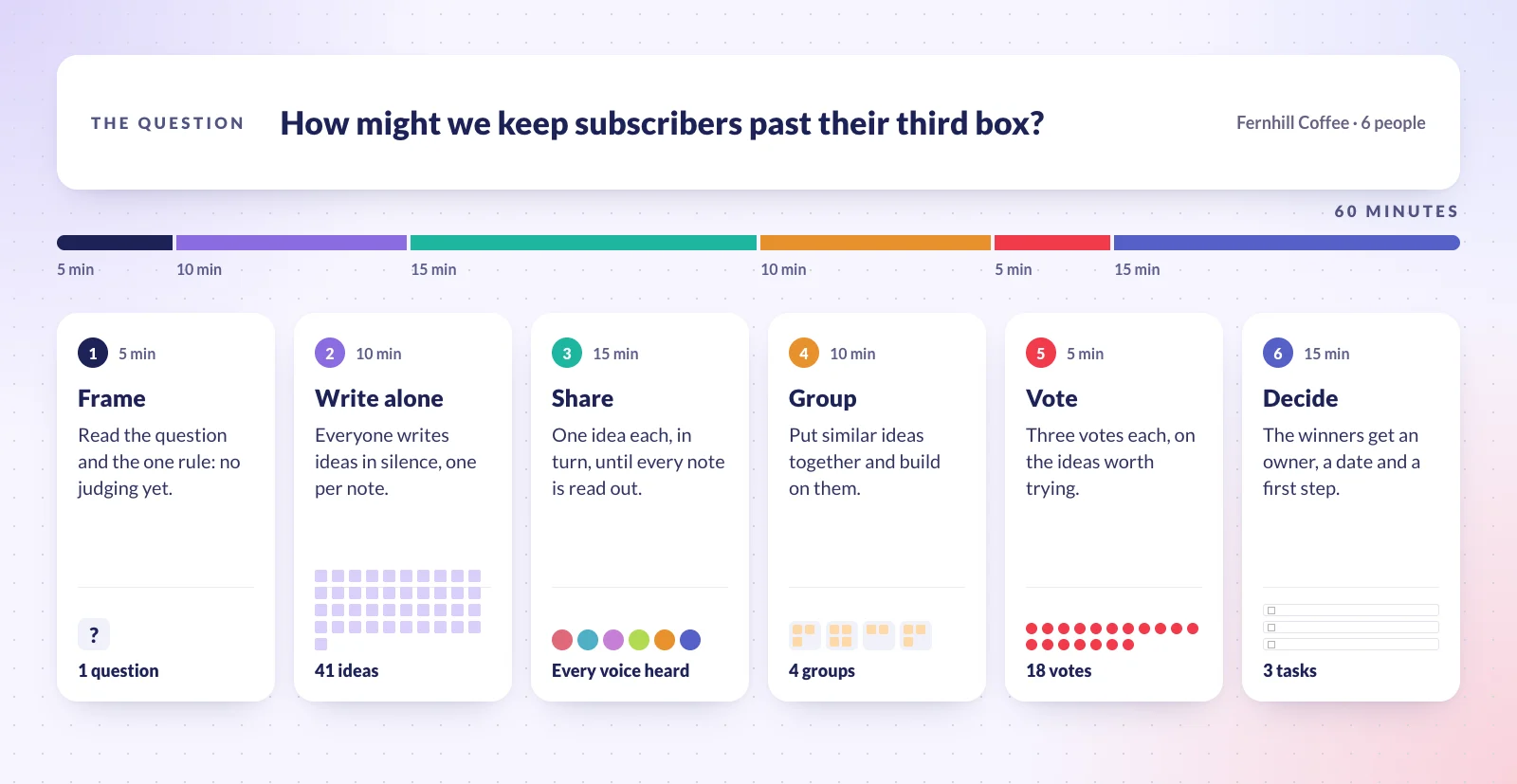
| 1. Frame (5 min) | Read the question aloud, say why it matters now, and repeat the one rule that matters most: no judging until the vote. |
| 2. Write alone (10 min) | Everyone writes ideas in silence, one per sticky note or card, as many as they can. Nobody talks. |
| 3. Share (15 min) | Go round the room: each person reads one idea and puts it up, then the next person. Repeat until every note is out. New ideas sparked along the way go up too. |
| 4. Group and build (10 min) | Move similar ideas together and name each group. Look for ideas that combine into a better one, and add them. |
| 5. Vote (5 min) | Each person gets three votes to place on the ideas most worth trying, all at once so nobody follows anyone else. Two votes on one idea is allowed. |
| 6. Decide (15 min) | Take the top two or three. For each one, agree the smallest next step, who owns it and by when. Everything else is kept, not thrown away. |
Steps 2 and 3 are the ones teams skip, and they're what makes the difference. Ten silent minutes give every person a full list before anyone speaks, and taking turns means the quietest person's best idea gets read out as loudly as the manager's. If you've played planning poker, it's the same trick: decide alone, reveal together.
After the Session
A brainstorm is only as good as what happens the next day. Within 24 hours, send the team the question, the top ideas with their owners and dates, and where the full list lives. Then put the next steps where the team's work already is, so they get done like any other task. Most ideas die not because they were bad, but because they were left on a whiteboard.
7 Brainstorming Techniques, and When to Use Each
The session above works for most questions. These techniques slot into step 2 or 3 when you need something different: more ideas, safer ideas from a nervous room, or a way into a problem the team is stuck on.
| Technique | How it works | Use it when |
|---|---|---|
| Brainwriting (6-3-5) | Six people each write three ideas in five minutes, then pass their sheet to the next person, who builds on them. Six rounds give up to 108 ideas without anyone speaking. | A few voices usually dominate, or you need a lot of ideas fast. |
| Round robin | Go round the group, one idea per person per turn. Anyone can pass, and the round ends when everyone passes. | You want every person heard, in a live or video session. |
| Reverse brainstorming | Ask the opposite question, "How could we make this worse?", collect the answers, then turn each one around. | The team is stuck, or the problem is a familiar one with familiar answers. |
| Starbursting | Write the idea in the middle and generate questions, not answers: who, what, where, when, why and how. | You have an idea and need to find its gaps before committing to it. |
| Mind mapping | Put the question in the center and branch out by theme, adding ideas to each branch. | The problem is broad and you need to see its parts before generating ideas. |
| Crazy 8s | Fold a sheet into eight panels and sketch one idea per panel, one minute each. | The ideas are visual: a screen, a package, a layout. |
| Rolestorming | Each person answers as someone else: a new customer, a competitor, the CEO, a support agent. | The ideas all sound alike, or people are wary of putting their own name to a bold one. |
Team Brainstorming Example
Here's the session from the diagram above in full. The company and the people are made up: Fernhill Coffee, a 30-person roaster, sells most of its coffee as a monthly subscription, and too many subscribers cancel before their third box.
| Question | How might we keep subscribers past their third box? |
|---|---|
| People | Six: Ana (marketing), Ben (design), Chloe (product), Eli (data), Dani (customer support) and Farah (head roaster). Chloe facilitated. The question went out two days earlier, with one number: 31% of subscribers cancel before box 3. |
| Ideas | 41 in ten silent minutes. Dani's notes were the most specific: the reasons customers give when they call to cancel. |
| Groups | Four: the first box (9 ideas), choice and flexibility (12), price (8), and the story behind the coffee (12). |
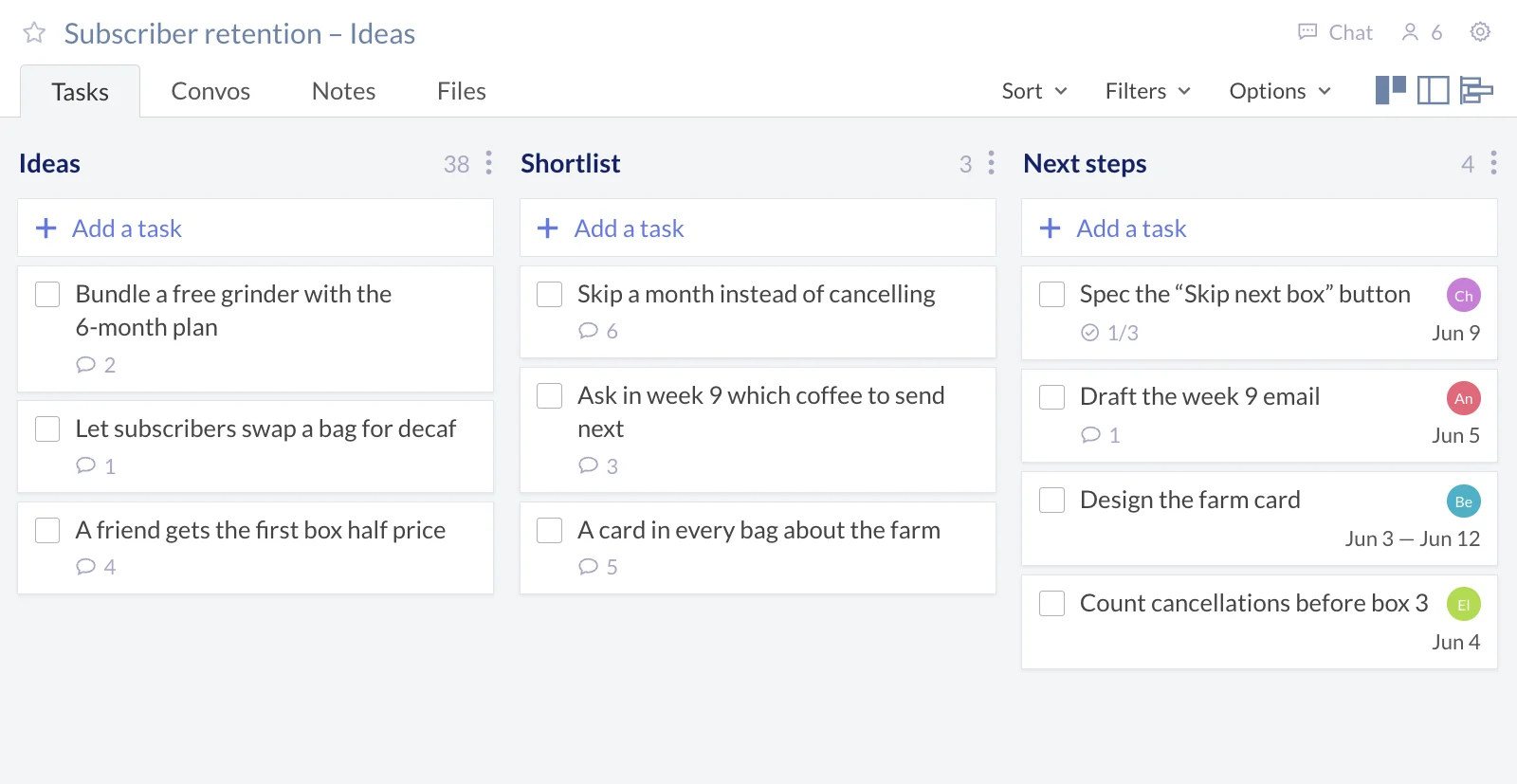
| Top three | Skip a month instead of cancelling (6 votes): most people who cancel just have too much coffee. Ask in week 9 which coffee to send next (5 votes): a choice before the third box, when cancellations peak. A card in every bag about the farm (4 votes): Farah's idea, built on by Ben during the grouping. |
| Next steps | Chloe specs a "Skip next box" button by June 9. Ana drafts the week 9 email by June 5. Ben designs the farm card by June 12. Eli counts cancellations before box 3 by June 4, so the team can tell whether any of it worked. |
Notice what the team didn't do: debate the 38 other ideas. They stayed on the list, where the next session on the same question can pick them up.
Brainstorming With a Remote Team
A remote team can't stand around a whiteboard, but it has an advantage: nobody has to wait for a meeting to have an idea. People have their best ideas at different times, and not always the ones you'd expect. A 2011 study by Mareike Wieth and Rose Zacks found that people solved insight problems better at their least alert time of day: morning people in the evening, night owls in the morning. A 9:00 session catches some of your team at their best and some at their worst.
- Open the question before the meeting. Post it in a shared place two or three days ahead and ask for ideas there, one per item. That's step 2, done whenever each person thinks best.
- Keep the live part short. On a video call, skip straight to sharing, grouping and voting. 30 to 45 minutes is enough when the ideas are already written.
- Leave it open afterwards. Someone who missed the call, or who has the best idea of all on the train home, adds it to the same list.
Keep the Ideas in Redbooth
The list of ideas, the shortlist and the next steps all belong in the same place, so ideas can't get lost between the session and the work. In Redbooth, that's a workspace, or a set of task lists in the workspace of the project the question is about:
- Make each idea a task in a task list called "Ideas". Anyone can add one at any time, and teammates build on it in the task's comments, so the "yes, and…" happens even between meetings.
- Shortlist in the board view. After the vote, drag the winners from "Ideas" to "Shortlist" on the Kanban board. The rest stay where they are, ready for next time. Boards, tasks and comments are on every plan, Free included.
- Turn each winner into next steps. Add the first step as a task in "Next steps", with one owner and a due date, and subtasks if it has parts. Now it shows up in the owner's tasks like any other piece of work.
- Hold the live session from the workspace. HD video meetings, powered by Zoom, start from inside a task or a workspace, on the Pro plan and above.
If the team that brainstorms together also works together for months, it's worth agreeing how it decides things once, in writing: our team charter guide has a template. And for client work, see how agencies run their projects in Redbooth.
Mistakes to Avoid
- Starting with discussion. The first idea spoken sets the direction. Write first, talk second.
- A question that's too broad. "How can we grow?" gets you slogans. Narrow it to one group of people and one result.
- The boss goes first. Everything after it is a variation on the boss's idea. Managers share last, or anonymously.
- Judging during the session. One "we tried that in 2019" and the next idea doesn't get said. Save it for the vote.
- Ending without owners. A session that ends with "great ideas, everyone" ends there. No idea leaves the room without a name and a date.
- Throwing the list away. The ideas that lost today are the starting point for the next session on the same question.
Questions People Ask
What is team brainstorming?
A structured session where a group generates as many ideas as possible in answer to one question, without judging them, then groups them, votes, and picks a few to act on.
What are the four rules of brainstorming?
Alex Osborn's original rules: don't judge ideas during the session, go for quantity, welcome wild ideas, and combine and build on each other's ideas. Many teams add a fifth: write ideas alone before sharing them.
How many people should be in a brainstorming session?
Four to eight. Fewer, and you lose the variety of views; more, and people wait too long for their turn. Split a larger group into smaller ones on the same question and compare their lists at the end.
How long should a brainstorming session last?
About 60 minutes for a session that starts from nothing, or 30 to 45 minutes if people sent their ideas in beforehand. After that, energy and the quality of ideas drop.
What is brainwriting?
A brainstorming technique where people write ideas instead of saying them, then pass them on for others to build on. The best-known version, 6-3-5, has six people write three ideas in five minutes per round.
For your next session, start with the question: write it as "How might we…", send it out two days ahead, and give the first ten minutes to silence.